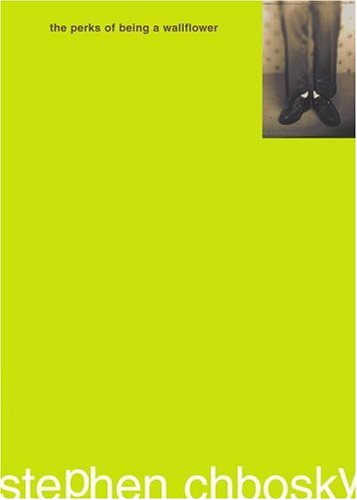
The Perks of Being a Wallflower – Stephen Chbosky

“[...] I am both happy and sad, and I’m still trying to figure out how that could be.”


The Perks of Being a Wallflower is simply about happiness, and all its facets. It narrates the freshman year of high school of Charlie, a kid that, as the title would suggest, is a wallflower: “You see things. You keep quiet about them. And you understand.” So Charlie has this personality that makes him observe and analyze everything, which turns the book into a deep philosophical and psychological analysis of everyone he sees.


This makes for a book in which the story isn’t that important, but Charlie’s observations are. That’s not to say that the plot is bad or anything, it’s just that I felt that the life lessons that are brought up though it ­–which I’m not even going to try to reproduce – were a lot more important. He brings up great view on growing up, friendship, couples, family, art, traditions, literature, death, and most importantly, happiness. This is all possible thanks to Charlie’s particular personality, which I must admit Chbosky did a great job at creating and putting into words; Charlie’s words.


The thing that I liked the most about the book was how Charlie was so honest about how he felt about everything. How he rarely hid anything, especially from the reader. It’s like he was touching on those things that we all think, that we all have gone through, and managing to talk about them in an open, pure and sort of innocent way that somehow made them a lot more clear.


There is a big dilemma posted in this book; that of passivity vs. action. Of rationalization vs. passion. Charlie is a very gifted character and his deep analyses often make him stay out of the action that is life. In the end, it is clear that the most important thing is to find the balance, because it is only at these moments when Charlie is happy.


In the end, this was a wonderful book about life lessons. A book that I think every high school student in the world should read, for it brings a beautiful new perspective and order to this chaotic part of life.


PS: I’m kind of liking this whole start with a quote from the book business. I think I might do it from now on.

The Bell Jar – Silvia Plath

[SPOILER ALERT]


“I felt very still and very empty, the way the eye of a tornado must feel, moving dully along in the middle of the surrounding hullabaloo.”


That quote describes this book just perfectly. The Bell Jar is a testament to loneliness; to the loneliness we feel when we don’t know who we are; to the loneliness we feel when we go insane.


The story is about a girl, Esther, who’s in the pinnacle of her life: she’s won several scholarships for college, she’s about to graduate and nothing in her life seems wrong. But here’s when her problem strikes. Her problem is that she doesn’t know who she is, or who she wants to be. Her boss wants her to be a successful editor. Her mother wants her to learn practical skills that are not as abstract as literature. Her boyfriend wants her to simply get married, have children and drop her professional carrier. And her... well she has no idea who she wants to be.


Plath makes a beautiful job describing how lonely this makes Esther feel, and how she fails to connect with anybody because of it. And eventually... well it turns to be too much for her, and she decides to kill herself. Esther seems so rational about this that it makes the reader wonder whether it really is the right choice. So, basically, she goes insane – insane enough that after her suicide attempt she ends up in an asylum.


And here’s Plath’s real gift shows up. It’s amazing to see how the voice of the narrator doesn’t change at all before and after Esther’s insanity, and yet everything she does, and everything everyone around her does changes dramatically. As a reader, you still feel connected to Esther, and you can still see her in her insanity; and yet, everything around her changes. The most amazing thing is that even though Esther is insane, and she has accepted this, she seems to be the only sane person in the story. Everyone does inexplicable things, that Esther doesn’t understand and that she doesn’t bother to ask about, and that ass a reader seem... well, crazy. All these things add up to leave Esther in an inexplicably lonely world, where nobody around her understands her, and everyone is insane.


So the book is good. It’s a really powerful read, and it becomes more powerful when you read Plath’s biography. It turns out The Bell Jar is her own life, with some elements of fiction thrown in to add to it. She went to college on a scholarship, she had a suicide attempt, and she was in an insane asylum for six months. I guess this book was her way to try and explain what she felt though those awful times, and I doubt she could have done a much better job. No wonder it's a classic.

Harry Potter and the Deathly Hallows – J. K. Rowling

[Why Not start with something that will make everybody hate me?]


This is the kind of book for which I wish I had the phone number of all its hardcore fans ­­­­– and by extension the series – just to call them up, say “really?” in the most high pitch, smug voice I can concoct, and immediately hung up after that. I honestly fail to see how it managed to reach the level of popularity it did.


The plot has the depth of a mud puddle. It was one of the emptiest, flattest books I’ve read in a while. It just felt like a movie turned into a book. Books are supposed to be books, and movies are supposed to be movies. They both tell stories, but they aim at completely different things. HP limited itself to telling a story; a fun, entertaining story, but a just story nonetheless. I don’t think it’s possible for the readers to get something out of the book other than the story itself.


Regarding the story itself... well, I just don’t think I get it. Yes, it was fun sometimes, and the last chapter was so eventful that nothing but those pages exist when you’re reading it. But, I still found the book to be dull. Most of the book lacked tension, so I didn’t really felt compelled to continue reading it. And after ploughing through the book, the story itself proved not to be that exciting.


All this aside, however, Rowling is an amazing writer. When it comes to pace, few other books can keep up with hers. She paints images and pictures simply wonderfully. So well, that no reader can say they lost any of the action because of her writing. And she has this something that I can’t manage to pinpoint that somehow explains her success.


All in all, the book was... a kid’s book. A meaningless, yet undeniably fun book. Something that you give your 12 year old to make them read something. Something to pass the time while commuting to school, or waiting at the airport.

The future of this fiasco

I just want to do a quick update to announce what this blog is going to turn into. I've barely been writing usually, and that's because a)I'm awful at it; and b)I have no time whatsoever. BUT there’s something that I do have time for and that basically anyone can do: being judgmental. Why not criticise others for something they can do about a billion times better than me? So that’s why I’ve decided to take this failure of a blog in a new direction. I’ll be posting reviews of the books that I read, most likely right after I finish them. I might go back to books that I’ve read in the past, but almost exclusively I’ll be reviewing the books that I’m presently reading. I’ll be doing this, not because I think anyone at all reads this, but because I want to be able to come back in the future and see what I honestly thought of these books. I hope I can keep up with it, and I know I’ll enjoy doing it nevertheless. Here’s to the future of this blog!
PS: What the hell are you doing reading this crap?! Go do something productive.